 how-to
Are There Common Electrical Code Violations in Basements?
Last Updated: November 5, 2026
Quick Summary
The most common electrical code violations in basements are missing GFCI protection, missing AFCI protection, grounding and bonding deficiencies, overcrowded boxes, mismatched circuit breakers, exposed or unsupported wiring, and electrical work done without permits. Damp conditions, low ceilings, and weekend DIY finishes make these shortcuts common, and most stay hidden until an inspection or failure exposes them.
- GFCI protection is required in basements because the space is classified as a damp location.
- AFCI breakers are brand-specific, and a shared neutral can cause nuisance tripping.
- Box fill is the maximum number of conductors a box can safely hold based on its volume.
- A 20-amp breaker on 14-gauge wire is a common and dangerous mismatch.
- Call your local building department to confirm which NEC edition is adopted.
Table of Contents
- Why Basement Electrical Code Violations Are So Common
- 1. Missing or Improper GFCI Protection
- 2. AFCI Protection and Arc-Fault Requirements
- 3. Grounding and Bonding Deficiencies
- 4. Overcrowded Boxes and Box-Fill Limits
- 5. Mismatched Circuit Breakers and Overcurrent Protection
- 6. Exposed Wiring in Basement Code: What's Allowed and What Isn't
- 7. Electrical Permits for Basement Finishing
- Your Basement Electrical Inspection Checklist
- Frequently Asked Questions
Why Basement Electrical Code Violations Are So Common
The most common electrical code violations in basements tend to cluster around a handful of trouble spots: missing GFCI protection, overloaded boxes, and wiring that was never inspected.
Basements sit at the bottom of the house, and they get treated that way. A previous owner finishes a room on a weekend. A sump pump gets wired in a hurry.
Damp conditions make it worse: moisture and electricity are a bad pair, and low ceilings, concrete walls, and limited outlet access make shortcuts tempting.
Below, we cover the seven violations we see most often, plus a room-by-room checklist. If you would rather have a trained eye walk your basement, our electricians in Loudoun County handle inspections and corrections.
1. Missing or Improper GFCI Protection
The number one basement violation is a missing GFCI outlet.
An unfinished basement typically needs GFCI protection on its outlets. So does a finished basement near sinks, laundry areas, or any spot that can get wet.
Here is the mistake we find most: a homeowner swaps a standard outlet for a GFCI, but wires it to the "load" side of an upstream device. The result looks protected but isn't.
Basement Outlet Requirements You Need to Know
Basement outlet requirements go beyond GFCI. Outlets must be spaced so no point along a wall is more than 6 feet from a receptacle. Tamper-resistant receptacles are required in most habitable rooms, and finished basements count.
- GFCI protection on outlets in damp areas
- Tamper-resistant outlets in finished rooms
- Proper spacing along walls
- Cover plates on every box, no gaps
- Outlets set at a safe height above the floor
A basement that floods once a year needs outlets set higher, not just protected. We see this a lot in older homes.
2. AFCI Protection and Arc-Fault Requirements
The common violation is not a missing device in a new panel.
Code edition matters here. AFCI requirements expanded significantly between the 2005 and 2014 editions of the NEC, and later editions added receptacle-type AFCI options and expanded the rooms covered.
Retrofit realities:
- AFCI breakers are brand-specific. A breaker that fits the slot but not the panel can fail to trip or nuisance-trip.
- A shared neutral (multi-wire branch circuit) can cause nuisance tripping on some AFCI breakers unless the breaker is rated for it.
- Older wiring with degraded insulation may trip a new AFCI immediately, which is a finding, not a failure of the breaker.
- Replacing a standard breaker with an AFCI breaker is not a homeowner swap. It means opening the panel, matching the breaker to the panel brand and bus, and verifying the circuit is compatible.
Severity: a missing AFCI on a basement bedroom or rec room circuit is a genuine fire-life-safety concern and should be corrected before the space is used as living area.
If you find a breaker that trips repeatedly after an AFCI retrofit, do not keep resetting it. That pattern usually means the AFCI is doing its job and the circuit has a real fault. Book electrical repairs in Loudoun County so a licensed electrician can test the circuit and correct the underlying issue.
3. Grounding and Bonding Deficiencies
Grounding gives stray current a safe path back to earth. Bonding ties metal parts together so they stay at the same voltage.
- A ground wire cut short and left hanging
- Metal water and gas piping not bonded
- A subpanel fed with only three wires and no separate ground
- Receptacles with no ground, replaced by a "cheater" plug
That last one is a fire and shock hazard hiding in plain sight. An ungrounded outlet near a concrete floor is a serious risk.
If you suspect a grounding problem, stop using the circuit and book electrical repairs in Loudoun County so a licensed electrician can test and correct it.
4. Overcrowded Boxes and Box-Fill Limits
Box fill is the maximum number of conductors a box can safely hold, and it is set by code based on box volume.
Every wire, every splice, every device counts toward the limit. Add a dimmer, a second cable, or a pigtail, and a box that was fine last year is now overfilled.
Signs of an overfilled box:
- Wires crammed in and the cover won't sit flat
- Scorched or discolored insulation
- Warm cover plates
- A faint burning smell near an outlet
Heat builds up in a packed box. Insulation softens. Eventually, it fails. The fix is a larger box or a second box, and it is cheap compared to a fire.
5. Mismatched Circuit Breakers and Overcurrent Protection
A breaker that does not match its wire is a fire waiting for a load. Overcurrent protection means the breaker trips before the wire overheats, and that only works if the breaker size matches the wire gauge.
Common mismatches we find:
- A 20-amp breaker on 14-gauge wire
- A 15-amp breaker on a circuit feeding a big appliance
- A breaker from the wrong panel brand, forced into place
- A double-tapped breaker with two wires under one lug
Breakers are brand-specific for a reason. A breaker that fits the slot but not the panel can arc, overheat, or fail to trip. If you see a breaker that looks "close enough," it isn't.
6. Exposed Wiring in Basement Code: What's Allowed and What Isn't
Exposed wiring in basement code is a gray area for a lot of homeowners.
NM cable, often called Romex, can run exposed in some unfinished basement areas.
Violations we see:
- Cable draped over pipes or hanging from joists
- Cable run through studs without protection plates
- Cable stapled too tight, crushing the insulation
- Extension cords used as permanent wiring
- Power strips daisy-chained across the floor
That last trio, extension cords, power strips, and daisy chains, causes more basement fires than almost anything else. Cords are for temporary use.
If your basement has exposed or damaged wiring, our electrical installation team in Loudoun County can run it correctly and to code.
7. Electrical Permits for Basement Finishing
Electrical permits for basement finishing are required in most jurisdictions, and skipping them is a violation in itself. A permit triggers an inspection, and the inspection is what catches everything above.
Code adoption is not uniform. The NEC is a model code.
How to verify what applies to you:
- Call your local building department and ask which edition of the NEC is currently adopted and whether local amendments apply to residential basement finishing.
- Ask whether the electrical permit is issued by the city, the county, or a state-level authority, because the answer changes who inspects the work.
- Ask what the inspection sequence is, rough-in inspection before drywall, final inspection after devices and cover plates are installed, so you do not close up walls before the first inspection.
- Ask whether the AHJ requires AFCI protection, GFCI protection, tamper-resistant receptacles, and box-fill calculations to be shown on a plan or verified at rough-in.
What an inspection actually checks:
- GFCI and AFCI protection
- Grounding and bonding
- Box fill and cable support
- Breaker and wire matching
- Labeling at the panel
- Cable protection where it passes through framing
Prioritizing what you find: not every violation carries the same urgency. A reasonable triage order is:
- Immediate danger: scorch marks, a warm panel, a burning smell, a breaker that trips repeatedly, or an ungrounded outlet near a concrete floor. Stop using the circuit and call a licensed electrician.
- Life-safety and likely inspection failure: missing GFCI in damp areas, missing AFCI on habitable-room circuits, double-tapped breakers, mismatched breaker and wire gauge. Correct before the space is used as living area.
- Code compliance and resale risk: missing permits, unlabeled panels, unsupported cable, overcrowded boxes. These may not fail immediately but will surface at inspection or sale.
- Housekeeping: cover plates, labeling, cord management. Low urgency but cheap to fix.
Homeowners skip permits for two reasons: cost and time. Both are smaller than the cost of tearing out finished drywall to fix unpermitted work, and unpermitted work can complicate a sale, an insurance claim, or a future inspection.
If you are planning a finished basement, our basement finishing service in Loudoun County handles the electrical scope and the permit process together, so nothing gets missed.
Your Basement Electrical Inspection Checklist
Use this checklist to triage your own basement.
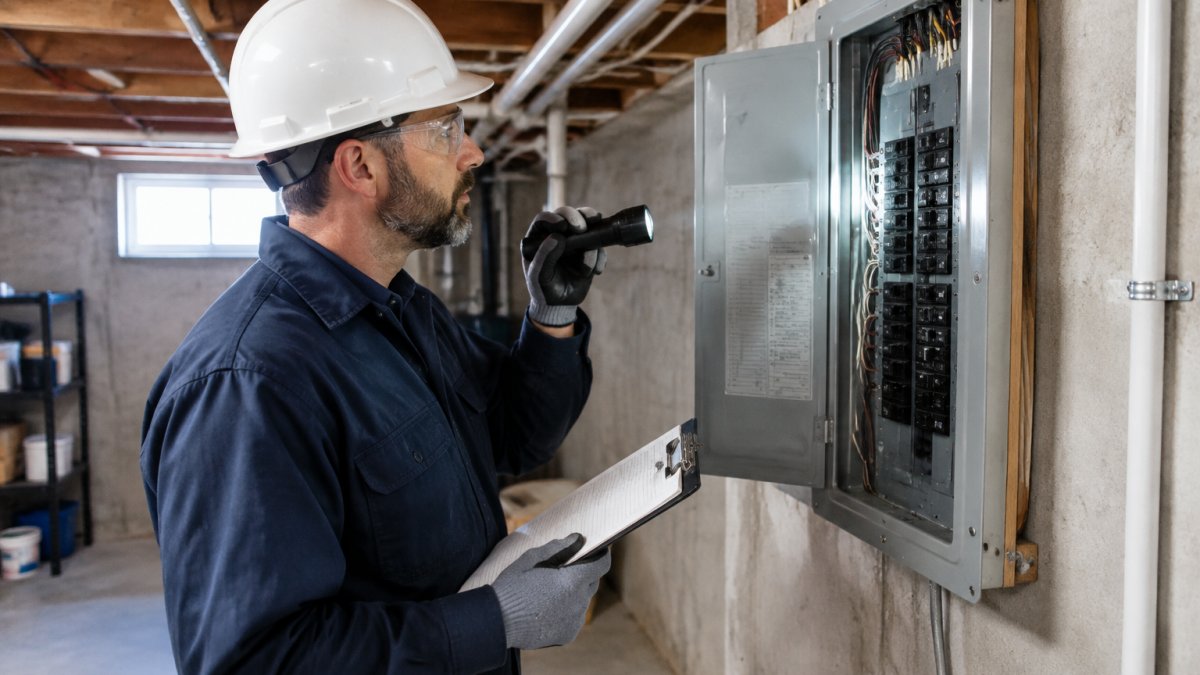
Panel and breakers
- Breakers match the panel brand
- No double-tapped breakers
- Breaker sizes match wire gauges
- Panel labeled clearly
Outlets and GFCI
- GFCI outlets in damp areas
- Test and reset buttons work
- Tamper-resistant outlets in finished rooms
- No ungrounded outlets near concrete
Wiring and boxes
- No exposed or damaged cable
- Boxes not overcrowded
- Cable stapled and supported
- No extension cords as permanent wiring
Moisture and safety
- No water stains near wiring
- Outlets set above flood level
- No scorch marks or burning smells
A common mistake is checking only the finished rooms.
Finished versus unfinished basements: an unfinished basement still needs GFCI protection and proper support for exposed cable.
If you are moving from code questions into hiring, our guide to basement finishing contractors in Haymarket covers what to ask before you sign.
Most basement electrical problems started as small, well-meaning shortcuts, and they stay hidden until something fails.
The article groups what an inspection checks and how urgently each finding should be handled.
| Priority | Examples | Action |
|---|---|---|
| Immediate danger | Scorch marks, warm panel, burning smell, breaker that trips repeatedly | Stop using the circuit and call a licensed electrician |
| Life-safety and likely inspection failure | Missing GFCI in damp areas, missing AFCI on habitable-room circuits, double-tapped breakers | Correct before the space is used as living area |
| Code compliance and resale risk | Missing permits, unlabeled panels, unsupported cable, overcrowded boxes | May not fail immediately but will surface at inspection or sale |
| Housekeeping | Cover plates, labeling, cord management | Low urgency but cheap to fix |
Frequently Asked Questions
What are the most common electrical code violations in basements?
The most frequent basement electrical code violations include missing or improper GFCI protection, absent AFCI protection on bedroom circuits, grounding and bonding deficiencies, overcrowded electrical boxes that exceed box-fill limits, mismatched circuit breakers, and exposed or improperly secured NM cable. Many of these issues stem from DIY wiring done without permits or inspections. A licensed electrician can identify these problems during a walkthrough and explain which ones need immediate correction versus routine upgrades.
Does a basement need GFCI-protected outlets?
Yes. Under the National Electrical Code, basement receptacles generally require GFCI protection because basements are classified as damp locations prone to moisture. Unfinished basements, laundry areas, and any outlet near a sump pump or floor drain are especially important. GFCI outlets shut off power when they detect a ground fault, reducing shock hazard. If your basement outlets lack the test and reset buttons, or if a GFCI fails to trip when tested, that is a violation worth correcting promptly.
Can you run Romex exposed in a basement?
It depends on the basement and the local code edition. NM cable, often called Romex, is generally permitted in unfinished basements when run along framing and protected from physical damage, but many jurisdictions require conduit or armored cable in exposed areas where the cable could be struck. Running NM cable across open ceiling joists without protection, or down a wall where it can be snagged, is a common violation. Check with your local building department, since adoption of NEC editions varies by jurisdiction.
What electrical work in a basement requires a permit?
Most basement electrical work requires a permit, including adding circuits, installing new outlets or switches, running wiring for a finished room, upgrading the electrical panel, and installing AFCI or GFCI protection. Replacing a like-for-like outlet or light fixture usually does not. Electrical permits for basement finishing protect you because the work gets inspected, and unpermitted work can complicate a future home sale or insurance claim. Confirm requirements with your local building department before work starts.