 how-to
How to Verify Contractor Insurance: A Homeowner's Step-by-Step Guide
Last Updated: November 4, 2026
Quick Summary
To verify contractor insurance, request a current certificate of insurance and call the insurance agent or carrier using a number you look up yourself to confirm the policy is active, its limits, and that it covers your type of work. A certificate alone is a snapshot, not proof of coverage.
- Ask for a certificate of insurance during the bidding stage, before you sign anything.
- Confirm the policy effective date is on or before the day work starts.
- Check that the expiration date falls after your projected completion date.
- Ask the agent whether the policy covers your specific project type.
- Request an additional insured endorsement for large projects, since a COI alone does not grant it.
Table of Contents
- Why Verifying Contractor Insurance Protects Your Home
- How to Ask a Contractor for Insurance Without Awkwardness
- Should I Ask a Contractor for Proof of Insurance? Yes, and Here's What to Request
- Reading a Certificate of Insurance for Contractors: A Sample Walkthrough
- How to Verify Contractor Insurance Online and Directly With the Insurer
- Checking Coverage Types, Limits, and Exclusions That Matter for Your Project
- What to Do When Coverage Cannot Be Verified or Has Expired
- Get a Free Estimate and See Proof of Insurance Firsthand
- Frequently Asked Questions
Why Verifying Contractor Insurance Protects Your Home
Learning how to verify contractor insurance helps protect your home, savings, and family from a worksite disaster.
The certificate itself is not the finish line. Anyone can print a form. Real protection comes from confirming the policy is active, covers your job, and is backed by the insurer.
The stakes are real. The Insurance Information Institute's guidance on home liability explains how homeowner liability works when someone is injured on your property.
So before you sign a contract, you need to know what to ask for and how to read it.
How to Ask a Contractor for Insurance Without Awkwardness
Asking feels rude to many homeowners. It isn't. A simple, direct request works best, and a good contractor expects it.
Try this line: "Before we start, could you send me a copy of your certificate of insurance and your license number?" No apology needed, you're doing normal due diligence.
A few tips that make it easier:
- Ask during the bidding stage, not after you've signed.
- Request it in writing by email so you have a record.
- Say you ask every contractor the same thing.
- If you're comparing several bids, ask them all at once.
Hesitation or dodging is a warning sign.
If you're building a shortlist first, this list of reliable home remodeling contractors in Northern Virginia gives you vetted local names to practice the ask with.
Should I Ask a Contractor for Proof of Insurance? Yes, and Here's What to Request
Yes, you should always ask, and you should ask for specific documents. A vague "we're insured" is not proof. Here's exactly what to request in writing:
- A current certificate of insurance (COI) from their insurer or agent.
- The contractor's legal business name as it appears on the policy.
- Their state license number, so you can check it.
- The name and phone number of their insurance agent, so you can call to confirm.
- A written confirmation that the policy covers your project type, especially if it involves plumbing or electrical work.
That last point matters: a general liability policy may exclude certain work, so confirm the scope is covered for big changes.
If you're planning a kitchen project, the guidance on choosing the best kitchen remodeling contractors in Ashburn pairs well with this document checklist. Vetting goes faster when you know what to ask for.
Reading a Certificate of Insurance for Contractors: A Sample Walkthrough
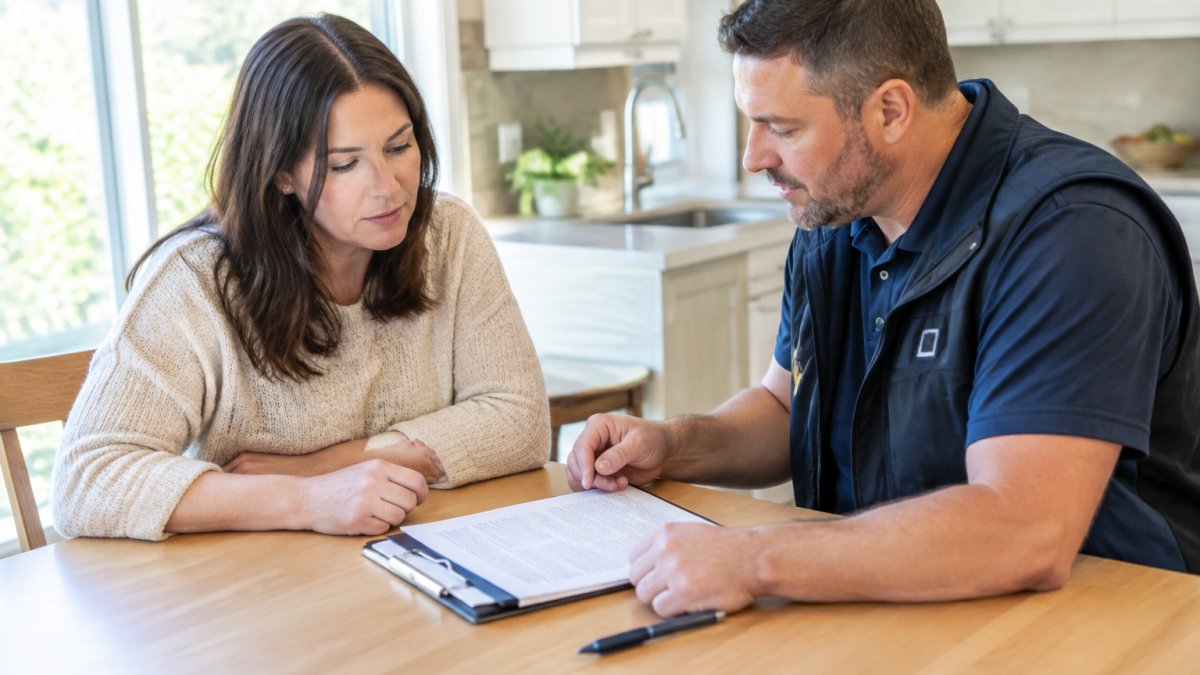
A certificate of insurance sample is easier to read than it looks once you know the fields that matter.
Insured block. This is the contractor's legal business name and address as the policy lists them. Compare it character-for-character against your contract and the state license lookup.
Policy dates. The effective date must be on or before the day work starts, and the expiration date must be after the projected completion date.
Description of operations / certificate holder. The certificate holder box should name you or your legal entity, with your project address.
Cancellation clause. Most certificates include a cancellation clause, which is a courtesy rather than a guarantee.
Discrepancies that should prompt follow-up before any work begins:
- The named insured does not match the contract or the license record.
- The policy expiration date falls before the project completion date.
- The certificate holder is someone other than you.
- The coverage grid is missing workers' compensation for a contractor with employees.
- The limits are lower than the project value or lower than what your contract requires.
- The producer phone number does not match the agency's published number.
- The form looks altered, different fonts, misaligned boxes, a policy number that does not follow the carrier's usual pattern, or a PDF with visible editing artifacts.
That is why the next step, calling the producer or carrier directly using a number you looked up yourself, matters more than anything printed on the page. The Insurance Information Institute's explanation of certificates of insurance walks through these fields in plain terms if you want a second reference.
One thing most people miss: a COI is a snapshot, not a guarantee.
How to Verify Contractor Insurance Online and Directly With the Insurer
You can verify contractor insurance online and by phone, and the phone call is the step that actually confirms coverage. Here's the process.
Start with the state license lookup. Most states let you search a contractor's license status online. Confirm the license is active and matches the business name.
Then call the insurance agent or carrier. Use the phone number on the certificate, but cross-check it against the insurer's official website, since scammers list fake numbers. Ask three questions:
- Is this policy active today?
- What are the coverage limits?
- Does it cover the type of work I'm hiring for?
Ask for an additional insured endorsement if your project is large. This adds you to the contractor's policy for your project, giving you extra protection.
Document everything. Save the certificate, the date you called, who you spoke with, and what they confirmed. A quick email summary to yourself works fine.
For official guidance on what coverage a licensed contractor should carry, check your state contractor licensing board requirements, since rules vary by state.
Checking Coverage Types, Limits, and Exclusions That Matter for Your Project
Several coverage types protect you in different ways. But the table is only the start, the numbers and the exclusions are where homeowners actually get burned.
| Coverage Type | What It Pays For | Typical Limits You Will See | Why You Care |
|---|---|---|---|
| General liability | Third-party bodily injury and property damage | $1,000,000 per occurrence / $2,000,000 aggregate is a common small-contractor baseline | Covers damage to your home or a visitor's injury |
| Workers' compensation | Employee injuries on the job, plus employer's liability | Statutory benefits, with employer's liability often $500,000 or $1,000,000 | Keeps a worksite injury off your homeowner policy |
| Commercial auto | Vehicle accidents while driving for the business | $1,000,000 combined single limit is common | Covers damage from a company truck or trailer in your driveway |
Coverage needs depend on the scope and risk of each project.
Exclusions are where claims actually get denied. Every policy has them, and the ones that matter most to homeowners are consistent across carriers:
- Your work / faulty workmanship. General liability typically excludes damage to the contractor's own work and the cost of fixing defective work. If a poorly installed shower pan fails and ruins the tile the contractor just laid, that repair may be on the contractor, not the insurer. The policy is more likely to respond to damage the defective work caused to other property, such as a failed supply line that ruins your finished basement.
- Damage to property in your care. If the contractor is storing materials in your garage and they are stolen, the policy may exclude that property.
- Auto incidents off the clock. An employee driving a personal vehicle to the job site is generally not covered by commercial auto.
- Injuries to the contractor themselves. Workers' compensation generally covers employees, not necessarily sole proprietors or partners. If the contractor is a one-person operation, ask how they handle their own injury.
- Subcontracted work. Some policies exclude or limit coverage for work performed by uninsured subcontractors. If the contractor uses subs, ask the agent whether the policy responds to subcontracted work and whether the contractor collects certificates from each sub.
- Mold, pollution, and water damage from certain sources. These are commonly excluded or sub-limited, exactly where bathroom or basement projects get bitten.
Claims scenarios make this concrete. Consider three common situations:
- A sub's employee is injured tearing out a wall. If the sub carries workers' compensation, the claim goes there. If not, it may fall to the general contractor's policy, or to your homeowner's policy if neither responds. This is why you ask the general contractor for certificates from every sub before they start.
- A company truck backs into your garage door. Commercial auto coverage may respond. If the driver was using a personal vehicle, the claim may go to the driver's personal auto policy.
- A new addition leaks and damages the flooring the contractor installed. The cost of redoing the contractor's own work is often excluded; damage to adjacent property may be covered. Knowing this helps you ask about workmanship warranties, which are separate from insurance.
Additional insured status and endorsements. A certificate alone does not make you an additional insured, and it does not waive the contractor's right to subrogate, that is, to pursue you or your insurer after paying a claim.
Coverage limits should match your project's risk. If the limits look low for the job size, or the exclusions overlap with the work you're hiring for, ask questions before you sign, and get the answers in writing.
What to Do When Coverage Cannot Be Verified or Has Expired
Sometimes the answer is no. The policy lapsed, the agent won't confirm it, or the numbers don't add up. Here's what to do.
- Ask for an updated certificate. Policies renew, and a good contractor will send a fresh one quickly.
- Pause the project. Don't let work start until coverage is confirmed.
- Walk away if it stays unresolved. An uninsured contractor is a risk you don't need to take.
- Check the business's background. If you're switching to a different contractor, review their about page and history before you commit.
Get a Free Estimate and See Proof of Insurance Firsthand
The best way to learn how to verify contractor insurance is to do it once with a contractor who welcomes the question. We're happy to be that contractor.
At Reo-ServicePro, we're a licensed and insured contractor. Owner Gary Golman brings 20 years of hands-on experience to kitchen, bathroom, and basement projects.
You can get a free estimate and see our proof of insurance firsthand. If you want to confirm our local credentials first, our general contractor service page covers what we do and where we work.
Get started with Reo-ServicePro and hire with confidence.
Frequently Asked Questions
How do I find out if a contractor has insurance?
Ask the contractor for a certificate of insurance (COI) before any work begins. The COI should list the contractor's legal business name, policy numbers, effective and expiration dates, and coverage limits for general liability, workers' compensation, and commercial auto. Then call the insurance agent or carrier listed on the certificate to confirm the policy is active and matches what you were given. A legitimate contractor will provide this without hesitation.
Can I verify a contractor's insurance online?
Some insurance carriers offer online policy verification portals, and many state licensing boards let you look up a contractor's license status and insurance filings. Start with your state's licensing database, then use the contact information on the certificate of insurance to reach the insurer directly. Never rely solely on a screenshot or a PDF emailed by the contractor, since those can be altered. A phone call to the carrier is the most reliable way to verify contractor insurance.
What should I check on a contractor's certificate of insurance?
Review the named insured to confirm it matches the contractor's legal business name, the policy types and coverage limits, the effective and expiration dates, and the certificate holder information. Ask whether you will be listed as an additional insured for the project. Also confirm that workers' compensation coverage is included, since a worksite injury without it could expose you to liability. If any field is missing or unclear, call the insurance agent before signing a contract.
What should I do if a contractor's insurance has expired?
Do not let work begin until you have current proof of active coverage. Ask the contractor for an updated certificate of insurance showing a new effective date and call the insurer to confirm it is in force. If the contractor cannot produce valid coverage, treat that as a serious warning sign and consider hiring someone else. An expired policy means any property damage or bodily injury on your project could fall back on you as the homeowner.